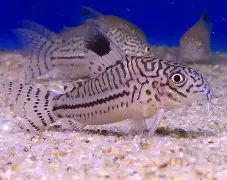
🪨 Species at a Glance
| Scientific Name | Corydoras trilineatus |
| Common Names | False Julii cory, Three-line cory, Leopard cory (sometimes) |
| Family | Callichthyidae |
| Order | Siluriformes |
| Origin | Western Amazon tributaries — Peru, western Brazil (upper Rio Solimões, Rio Ucayali, Rio Ampiyacu) |
| Adult Size | 5–6 cm (2.0–2.4 in) |
| Lifespan | 5–8 years |
| pH Range | 6.0–7.5 |
| Temperature | 22–26 °C (72–79 °F) |
| Hardness (dGH) | 2–15 |
| Diet | Omnivore bottom feeder — sinking wafers, pellets, frozen bloodworm, daphnia |
| Minimum Tank Size | 80 L (21 gal) for a school of 6+ |
| Care Level | Beginner |
| Temperament | Peaceful, social; must be kept in groups of 6+ |
| Breeding | Egg-depositor; T-position mating; beginner-friendly in the hobby |
| Tank Position | Bottom / substrate |
| Availability | Very common — almost always sold as “Julii cory” |
Species Background
Few fish in the hobby carry a naming story as tangled as the False Julii cory. The confusion goes back to the late 1960s, when Corydoras julii — described by Steindachner in 1906 from specimens collected in north-eastern Brazil — became fashionable as a decorative, patterned little catfish for community aquariums. The problem was straightforward: the true C. julii is uncommon in the wild, occurs only in a relatively narrow coastal drainage of eastern Brazil (the Rio Parnaíba basin and adjacent systems), and was almost never exported. Meanwhile, collectors in Peru and western Brazil were shipping vast numbers of a strikingly similar spotted-and-lined cory under the same common name. Wholesalers and shops, unable to distinguish the two species by eye at juvenile size, simply passed them on to customers as “Julii cory.” The fish most aquarists met — and still meet today — was never C. julii at all. It was C. trilineatus, a separate species described by Cope in 1872 from the upper Amazon. The two fish look alike enough as juveniles that the mix-up was understandable at first; what kept the mistake in circulation was commercial inertia — by the time taxonomists had clearly separated the two species, the label “Julii” was already printed on thousands of shop tanks and listed in every wholesale catalogue.
The name trilineatus is Latin for “three-lined,” and refers to the single most reliable identifying feature separating the two species. Corydoras trilineatus has three dark horizontal stripes running along the lateral midline of the body — one bolder central line flanked by broken or dotted lines above and below — and these lines are the key clue. True C. julii, by contrast, shows no continuous horizontal lines; instead, its body pattern is made up almost entirely of small, discrete round spots scattered randomly across a pale background. Both species share a spotted head and a similar body shape, which is why the confusion persists at a glance — but once you know to look for the line-versus-spot pattern on the flanks, the two are immediately distinguishable. The genus name Corydoras itself comes from the Greek kory (helmet) and doras (skin), a reference to the bony armoured plates running along the flanks of all callichthyid catfishes — a characteristic shared by all 170+ described species in this genus. Even the species epithet “julii” has its own small backstory: Steindachner named the fish in honour of a collector (likely a first-name reference, as was a Victorian-era convention) rather than after any anatomical feature, which is why the name itself gives no clue about appearance.
For decades, importers and even reputable aquarium books used the two names interchangeably, and the label “Julii” stuck as the default trade name regardless of which species was actually in the bag. Modern ichthyology and enthusiast communities have worked hard to untangle the mess — the Planet Catfish and ScotCat reference sites, as well as specialist cory breeders, have been consistently vocal about the distinction for over twenty years — and most serious hobbyist sources now flag the difference clearly. Yet shop tanks labelled “Julii cory” still almost always contain C. trilineatus, and asking a shop assistant to verify species identification often produces a blank stare. The practical upshot is simple: if you bought a “Julii cory” from a local aquarium shop in the last thirty years, the overwhelming statistical likelihood is that you bought a False Julii — C. trilineatus — and the fish you have is a very good one. The real C. julii, when it does appear, is treated as a collector’s specialty and often costs several times more than the everyday “Julii” in the same tank. Serious cory enthusiasts have largely made peace with the situation: they use the name “C. trilineatus” when precision matters, “False Julii” when communicating with casual aquarists, and accept that the genuine C. julii will always remain a rarity for the hobbyist who specifically hunts for it.
Creating the Perfect Habitat
The False Julii cory is a substrate-dwelling fish that spends most of its active hours moving over the bottom of the tank, pushing its sensitive barbels through the sediment to detect small morsels of food. The single most important decision for the tank is therefore the substrate: it must be fine-grained, smooth, and free of sharp edges. Fine aquarium sand (grain size 0.1–0.5 mm) is ideal, whether natural Amazon-style light sand or darker volcanic-sand substitutes. Coarse gravel — even the rounded pea-gravel common in beginner aquariums — is a problem, because the cory’s barbels work into the gaps between pieces and are gradually abraded. Chronically abraded barbels become infected, shrink, and in severe cases disappear entirely, impairing the fish’s ability to find food. A dark sand substrate has the added benefit of showing off the silver-and-black contrast of the body pattern, while light sand creates a bright, breezy aquascape reminiscent of a sun-dappled Amazon tributary.
An 80-litre tank is a sensible minimum for a school of six False Julii cory. A larger footprint — 90–120 litres, with more floor area — produces noticeably more natural schooling behaviour and is strongly recommended if tank space allows. Unlike many schooling fish, which need column space, corydoras need floor area: a long, shallow tank is always better than a tall one of the same volume. Decorate with driftwood, smooth-edged rocks, and dense planting. Live plants are very welcome — Java fern, Anubias, Amazon sword, Vallisneria, and Cryptocoryne all work well — and broad-leaved plants such as Amazon sword also serve as favoured spawning surfaces when the fish decide to breed. Avoid plants that require frequent substrate disturbance, because the cory’s constant foraging will unsettle them. Leave at least one open area of sand free of decor so the school has a clear foraging zone.
Floating plants are an under-appreciated addition for this species. False Julii cory feel most secure under gentle shade, and a partial cover of Amazon frogbit, red root floaters, or hornwort creates natural pools of dimmed light where the school rests between foraging bouts. Keep the tank securely lidded — corydoras are not jumpers, but they will dart up to the surface for a gulp of atmospheric air (a characteristic of callichthyid catfishes) and, more practically, a lid keeps heat and humidity inside the tank.
Tank
80 L (21 gal) minimum for 6 fish; 120 L (32 gal) or larger recommended for a comfortable school of 8–10 with ample substrate foraging area
Filter
Canister, hang-on-back, or mature sponge filter with moderate gentle flow; avoid strong jet-style returns that stir up sand
Heater
50–100 W adjustable thermostat heater, set to 24 °C; this is a moderate-temperature species, not a warm-water cory
Substrate
Fine smooth sand (0.1–0.5 mm) — essential for barbel health; avoid gravel and sharp-edged substrates
Lighting
Low to moderate intensity; floating plants or shaded areas preferred — the fish are more confident and active under subdued light
Driftwood & Caves
Provide retreat spots with driftwood, smooth rounded stones, and small caves; corydoras like to rest in sheltered corners between foraging bouts
Plants
Broad-leaved Amazon sword, Java fern, Anubias, Vallisneria; Amazon sword leaves are a favoured spawning surface
Thermometer
Independent digital thermometer — regularly cross-check against the heater setting to catch failures early
Lid
Well-fitting glass or mesh lid to retain heat and prevent jumping; corydoras rarely jump, but an open top invites evaporation-cooling problems
Water Chemistry Guide
6.0–7.5
ideal 6.8
22–26 °C
ideal 24 °C
2–15 dGH
Very broad tolerance: soft to moderately hard; tank-bred strains adapted to typical city tap water
If you know anything about wild Amazon biotope fishes, the stated pH range of 6.0–7.5 and hardness of 2–15 dGH for the False Julii cory will raise eyebrows. The wild habitat of Corydoras trilineatus — tributaries of the upper Amazon in Peru and western Brazil such as the Rio Ucayali, Rio Ampiyacu, and the upper reaches of the Rio Solimões — is genuinely soft, acidic blackwater, with pH often below 6.0 and hardness near zero. The substrates are sand and decomposing leaf litter; tannins stain the water the colour of weak tea; dissolved minerals are almost nil. How, then, can the fish in your local shop tolerate the decidedly hard, neutral-to-alkaline tap water that most city hobbyists work with?
The answer is generations of captive breeding. Almost every False Julii cory offered in the trade today is tank-bred, mostly in large Southeast Asian commercial fish farms where millions of juveniles are raised each year in water conditions that bear little resemblance to the Amazon. Over many generations, the captive population has adapted to a broader and harder water profile than their wild ancestors would have tolerated. The result is an exceptionally forgiving aquarium fish — one that shrugs off the minor water-parameter fluctuations typical of home aquariums and settles comfortably into city tap water almost anywhere in the world. Wild-caught C. trilineatus still appear occasionally in the specialist trade, and these fish are genuinely less flexible about water chemistry; they tend to do best in softer, more acidic conditions and are slower to settle in. For the standard tank-bred fish sold at typical aquarium retailers, though, you can think of the False Julii as one of the most genuinely beginner-friendly tropical fish available.
This hardiness is one of the main reasons the False Julii cory remains such a popular beginner corydoras. It does not demand RO water, peat filtration, or blackwater conditions to thrive, and healthy fish can be kept for years in ordinary community-tank conditions. That said, water quality — in the sense of cleanliness and low nitrate levels — remains critical. As bottom-dwellers, False Julii corys spend their entire lives in direct contact with whatever accumulates on the substrate, and high nitrate levels (chronic exposure above roughly 25–30 ppm) are a known cause of barbel erosion and secondary bacterial infections. Plan on weekly water changes of 25–30%, regular gentle substrate syphoning, and good biological filtration. Ammonia and nitrite must of course stay at zero — a fully cycled tank is non-negotiable. Temperature should stay in the 22–26 °C window — this is a temperate-tropical species rather than a discus-tank warm-water cory, and chronically high temperatures above 27 °C will shorten its lifespan by accelerating metabolism and reducing dissolved oxygen simultaneously. If you keep your room warm in summer, consider a small aquarium fan or cooling measures during heat waves to stop the water climbing above 27 °C for extended periods.
What to Feed
Corydoras trilineatus is an enthusiastic omnivore bottom-feeder. In the wild, it spends its entire active cycle sifting through sand and leaf litter for small invertebrates, insect larvae, worms, crustaceans, plant matter, and general organic debris — essentially anything edible that drifts down from the upper layers of the river or settles in the substrate. In the aquarium, it takes readily to a wide variety of prepared and frozen foods — indeed, this is one of the easiest corydoras to feed, and part of what makes it such a popular beginner species. The key requirement is that food must sink to the bottom. False Julii cory are physically unable to compete with mid-level or surface feeders and will not race tetras or rainbowfish for floating flakes; any food that stays at the surface or in the mid-column is effectively lost to them. Experienced keepers often describe the feeding moment in a community tank as a two-stage event: the tetras swarm the surface for the flake, and a moment later the sinking wafer reaches the bottom and the corys appear seemingly out of nowhere to investigate.
Build the staple diet around high-quality sinking pellets or wafers formulated for bottom-dwelling catfish. Look for a mix of protein (fish meal, shrimp, insect meal) and vegetable content, and rotate between two or three different brands to ensure variety and nutritional completeness. Hikari Sinking Wafers, Tetra Prima Bottom Feeder, and Fluval Bug Bites for bottom-feeders are all widely respected staples — any of them will work, and rotating between them is better than sticking to a single brand. Supplement two to three times per week with frozen bloodworm, frozen daphnia, frozen tubifex, or frozen brine shrimp. These frozen foods are eagerly consumed and noticeably condition the fish for breeding. Occasional live foods (live daphnia, microworms, white worms) are relished as treats but not required. A slice of blanched zucchini or cucumber, dropped in at lights-out, is readily grazed and adds useful fibre to the diet, though corys are more carnivorous than herbivorous and vegetable foods should be a minor part of the overall menu.
Feed two small meals per day rather than one large one, and time one of the feedings for just after lights-out — False Julii corys become more active in low light and will forage more confidently when their faster tankmates are settling for the night. A useful observation: in a well-fed cory school, you should see visibly rounded bellies from the side, and the fish should actively approach the front of the tank at feeding time. A hollow, sunken belly indicates either underfeeding (the corys are not getting enough sinking food past faster competitors) or poor water quality causing digestive stress. If in doubt, err on the side of feeding the corys separately by scattering sinking wafers in a quiet corner of the tank at lights-out, allowing them a feeding opportunity the other fish cannot easily intercept.
The Colour Spectrum
💠 Corydoras trilineatus (the “False Julii” in the trade)
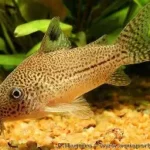
Silver-white body with three dark horizontal lines along the flank — one bold midline stripe plus a broken upper and lower line; head and dorsal fin finely peppered with small dark spots; dark-banded dorsal and tail fins. The standard fish sold as “Julii cory” in 95%+ of shops.
⚫ True Corydoras julii (the genuine article — rarely seen)
Silver-white body covered in small, discrete round spots with NO continuous horizontal lines on the flanks. Native only to north-east Brazil (Rio Parnaíba drainage and adjacent coastal rivers). Uncommon in the trade and typically priced as a collector’s species.
🟤 Corydoras leopardus (another common lookalike)
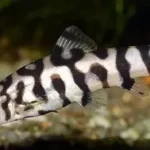
Similar spotted head and body pattern, but with a more diagonal dark band across the upper flank rather than three distinct horizontal lines. Occasionally shipped mixed with C. trilineatus under the generic “Julii” label.
🤍 Juvenile colouration
Young False Julii at 2–3 cm show less definition in the horizontal line pattern and can look very similar to several spotted cory species; adult pattern becomes fully clear between 4 and 5 cm.
Understanding which fish you are actually looking at is the single most useful thing a new False Julii owner can learn. Stand in front of the tank and look at the side of the fish: if you see three distinct horizontal lines running from behind the gill cover to the base of the tail — even if the upper and lower lines are broken into dashes or dots rather than continuous — you are almost certainly looking at Corydoras trilineatus, the False Julii. If instead you see a field of discrete round spots with no lines at all, you may have the genuine Corydoras julii, in which case you have something unusual and worth paying attention to. Mixed shipments were very common throughout the 1980s and 1990s, and a surprising number of hobbyists with decades of cory-keeping experience have never actually seen a true julii in the flesh. Other lookalikes in the trade include Corydoras leopardus (with an oblique rather than horizontal line pattern) and, less commonly, Corydoras similis — a reminder that the Corydoras genus contains many closely patterned species that only experts can reliably distinguish at a glance.
Beyond the basic line-versus-spot test, a few secondary identification features are worth noting. C. trilineatus tends to have a more angular, slightly elongated body profile compared to the chunkier, more compact true C. julii. The dorsal fin of the False Julii typically carries a broad black blotch at the top, while the tail fin shows vertical dark banding — features present in both species but often more heavily contrasted in C. trilineatus. The head pattern — fine dark peppering on a silver-grey base — is very similar in both species and is not useful for separating them. Size differences, too, are subtle: C. trilineatus reaches a slightly larger adult size (5.5–6 cm) than the generally smaller true C. julii (4.5–5 cm), but variation between individuals overlaps enough that size alone is not diagnostic.
The good news is that care requirements for all of these “Julii-group” species are broadly similar, so the mislabelling rarely causes husbandry problems. The bad news is that, for breeders trying to produce genuine julii for the serious hobbyist market, the decades of casual substitution make it very difficult to be sure of the parent stock without DNA work or at minimum careful expert examination. When buying from a reputable aquarium retailer, ask whether the fish are sold as C. trilineatus (the honest name) or “Julii” (the trade name) — the answer tells you a lot about how carefully the shop sources and identifies its livestock. Shops that list the fish by its accurate scientific name are usually the ones paying closest attention to species identification across their stock more generally. Finally, bear in mind that albino and long-fin forms of C. trilineatus have been developed in commercial breeding programmes over the last decade, though they remain uncommon in Australian shops and are usually imported to order for specialist keepers.
Sexual Dimorphism
Sexing the False Julii cory is most easily done by looking down at the school from above, through the surface of the tank. From this angle, the females are clearly broader across the body than the males — they appear plumper and more oval, while the males maintain a slimmer, more streamlined profile. This difference is most obvious once both sexes reach full adult size (around 5 cm) and becomes especially dramatic when a female is gravid and carrying a clutch of eggs. From the side, the cue is similar but more subtle: females have a fuller ventral line with a rounded belly, while males have a flatter, straighter ventral profile.
Colour, patterning, and fin shape do not reliably distinguish the sexes in this species. Both males and females carry the same three-line-and-spot pattern, and although some aquarists claim to see slightly more pointed dorsal fins on males, the difference is marginal and not a reliable cue for beginners. For practical purposes, the most sensible approach — especially for breeding — is to buy a group of six or more juveniles from a single batch and grow them out together. By the time they reach sexual maturity at around twelve months, the sex ratio will almost always include several males and females, and the size-and-shape differences become obvious. Sexually mature False Julii cory are among the most straightforward corydoras to identify by sex, and once you have sexed a single confirmed pair you quickly develop an eye for the subtle differences within the school.
| Feature | Male | Female |
|---|---|---|
| Body Shape (from above) | Slimmer, more streamlined torpedo profile | Noticeably broader and more oval, especially behind the pectoral girdle |
| Size at Maturity | Slightly smaller, typically 5–5.5 cm | Slightly larger, typically 5.5–6 cm, with some individuals reaching 6.5 cm |
| Belly Profile | Flatter, straighter ventral line viewed from the side | Rounder, more distended belly — especially obvious when gravid and viewed from below or in profile |
| Body Pattern | Identical horizontal-line and spot pattern to female | Identical pattern; no reliable colour or marking differences |
| Fins | Dorsal and pectoral fins can appear slightly more pointed in mature males | Fins typically rounder and shorter relative to body size, though this is a subtle and unreliable cue |
| Behaviour near Breeding | Active pursuit of females, side-by-side flanking, gentle nudging | Receives males in T-position; carries eggs cupped in pelvic fins between deposits |
Reproduction & Breeding
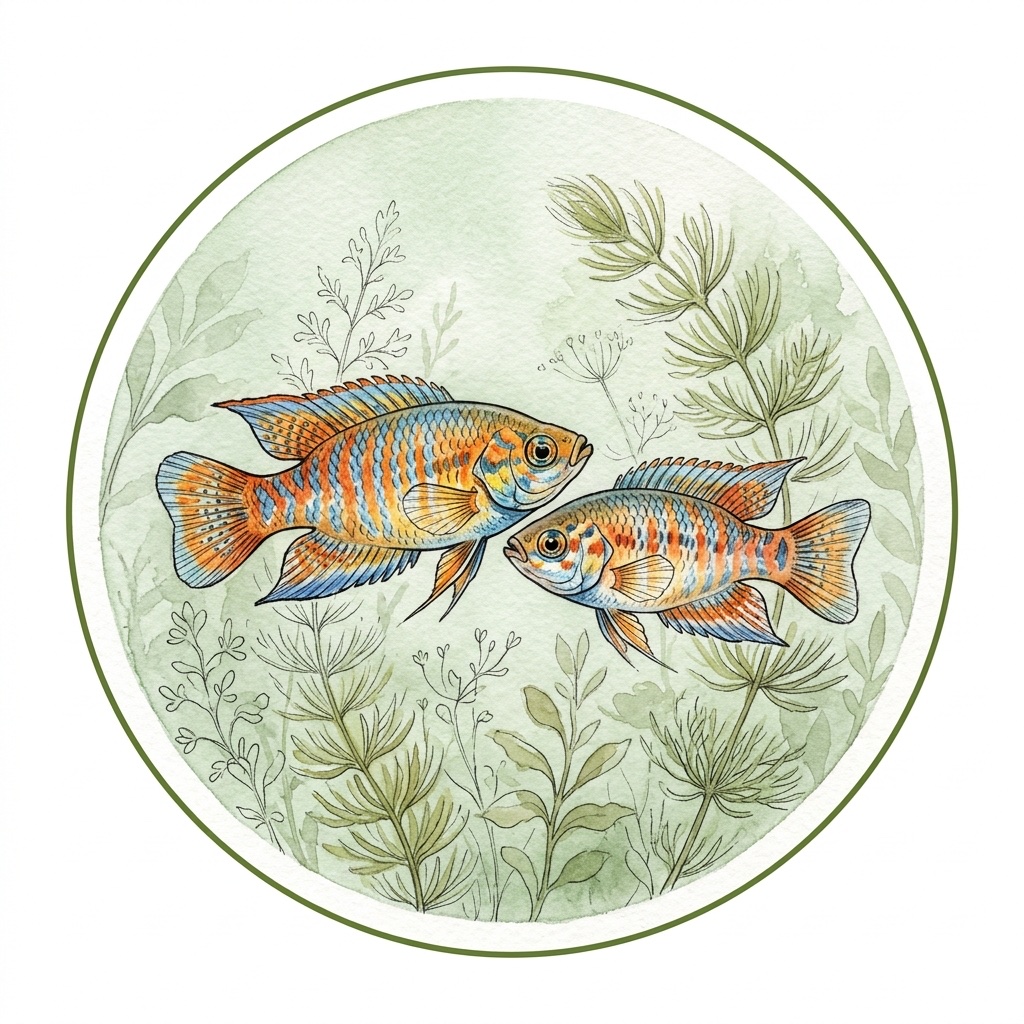
Week -2 to -1
Conditioning
Heavy feeding with live and frozen foods; stable warm temperature
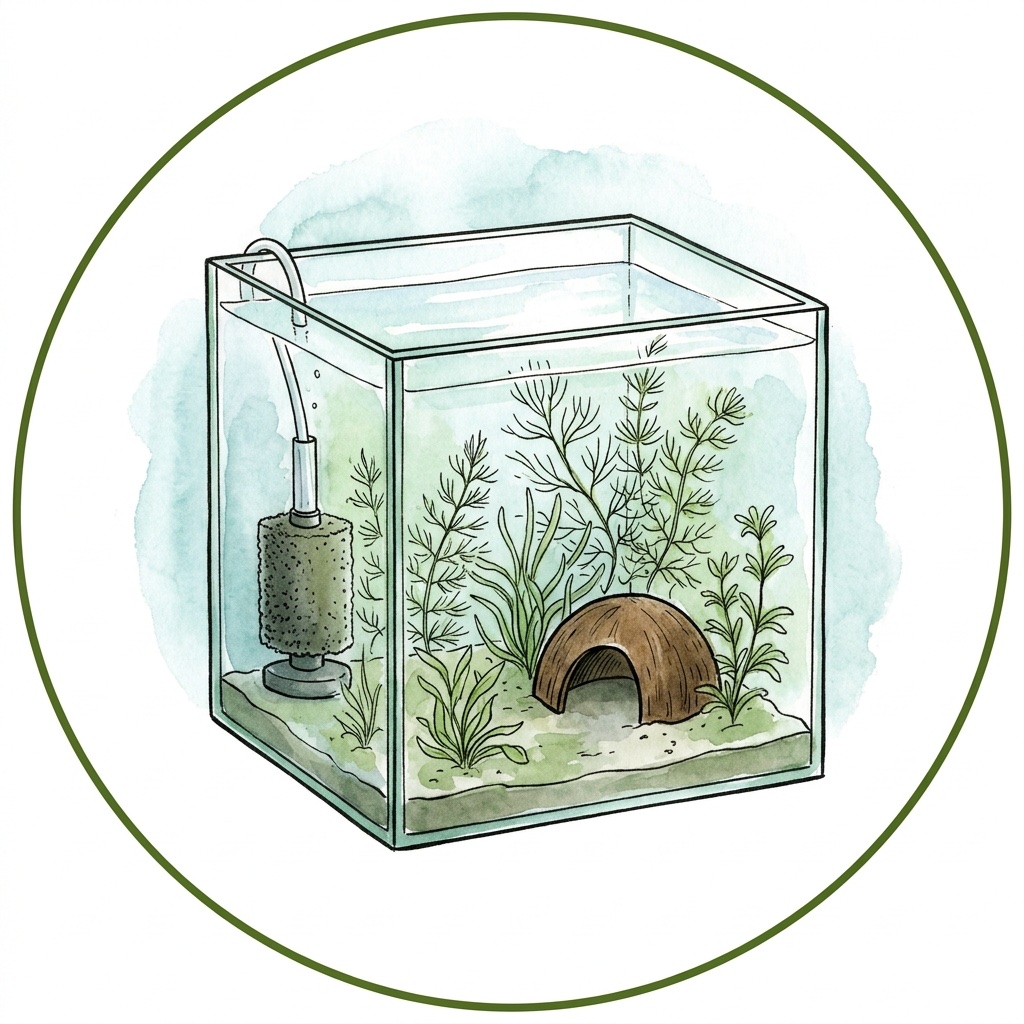
Day 0 — Trigger
Cold Water Change
Large water change with cooler water mimics rainy season
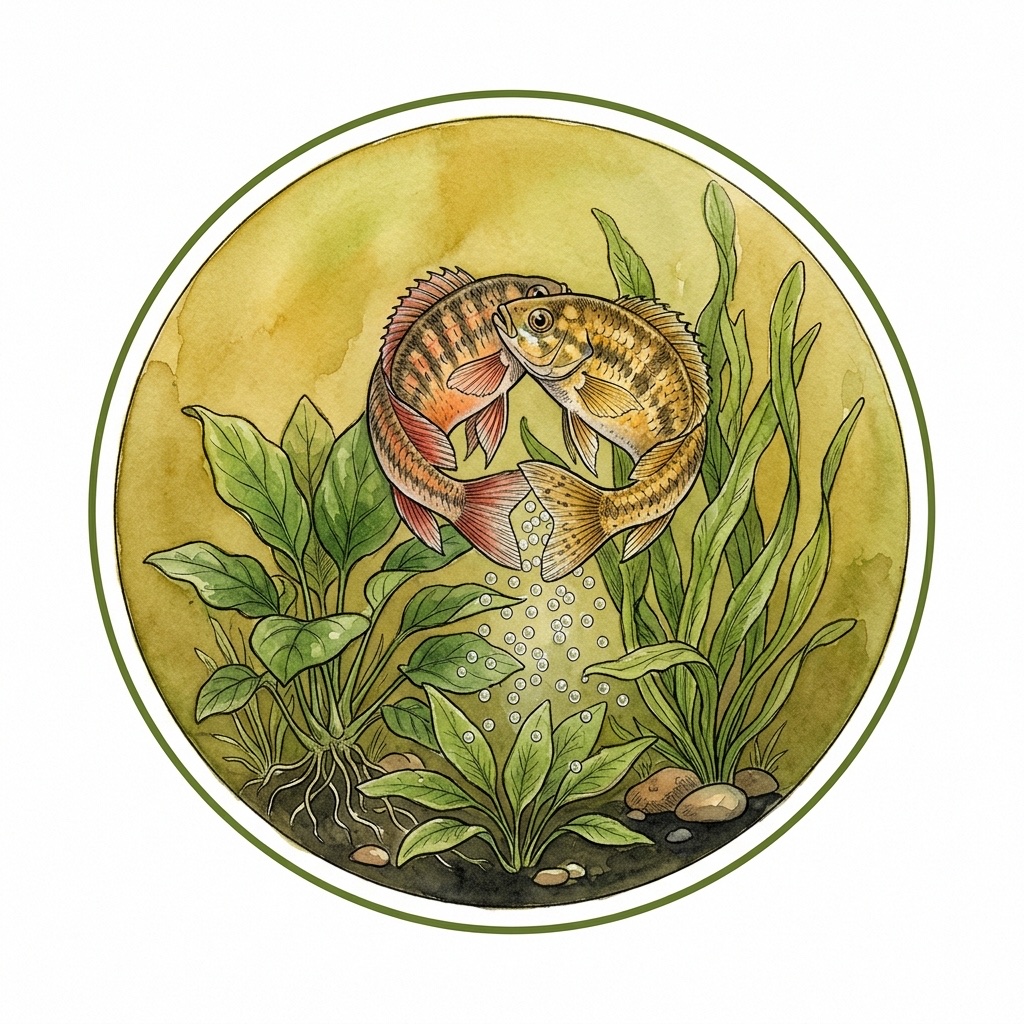
Day 1 — Courtship
Pursuit and T-Position Mating
Males chase female; mating occurs in characteristic T-position
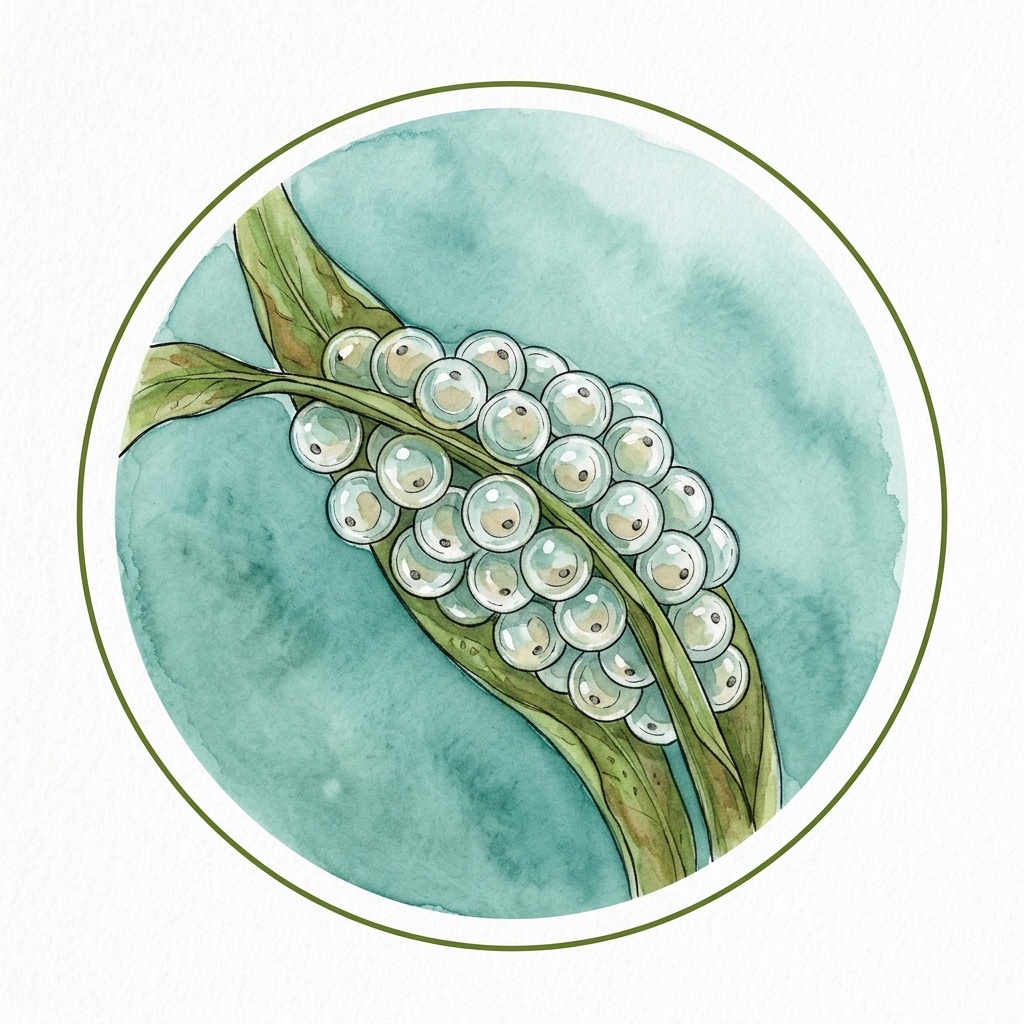
Day 1 — Egg Deposition
Female Places Adhesive Eggs
Cupped pelvic fins carry 2–6 eggs at a time to chosen surfaces
Day 2–4 — Incubation
Separate Eggs or Adults
Corys will eat their own eggs; remove parents or eggs
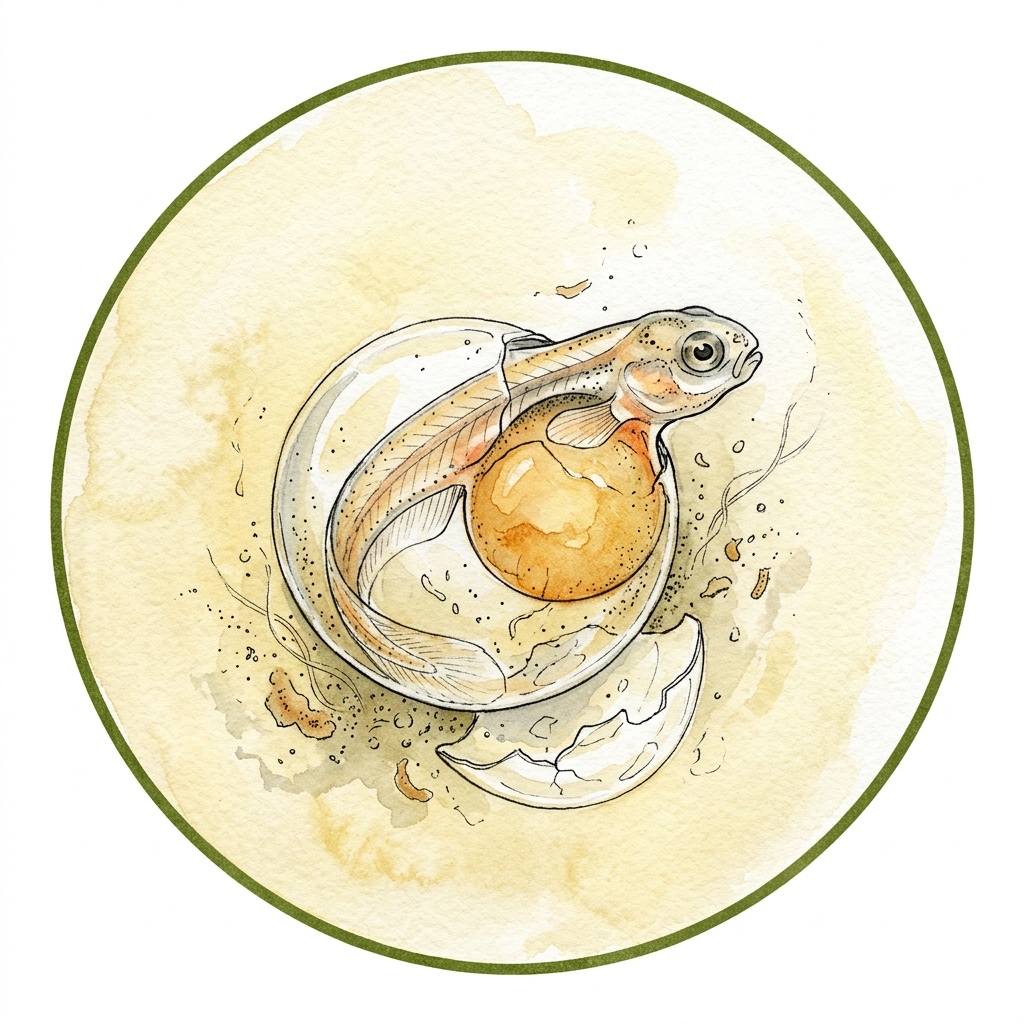
Day 4–6 — Hatching
Fry Emerge, Absorb Yolk Sac
Newly hatched fry are 4–5 mm and feed on yolk for 48 hours
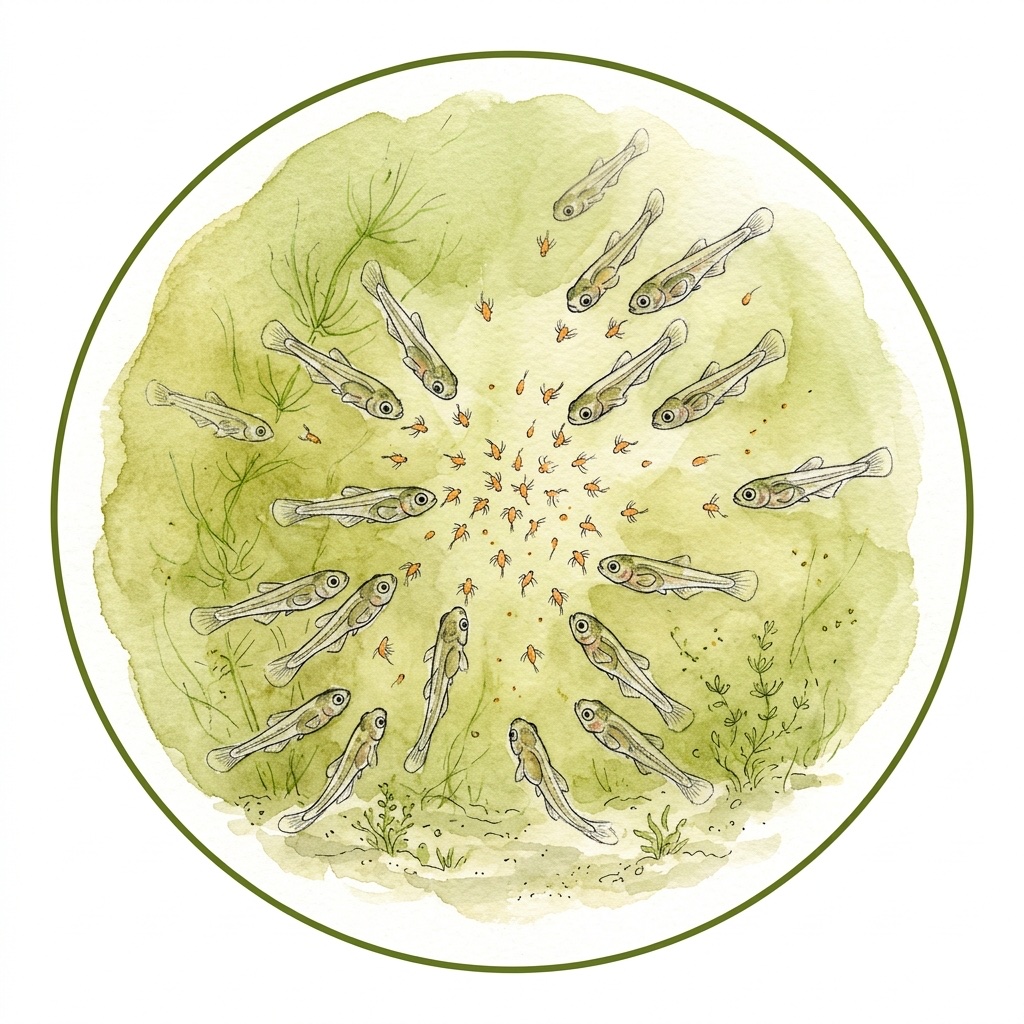
Week 2+ — Free-Swimming
First Feeding and Growing Out
Offer microworms, baby brine shrimp, liquid fry food
Conditioning
Begin conditioning the breeding group one to two weeks in advance by feeding generously with live or frozen bloodworm, daphnia, and brine shrimp — two or three high-protein feedings per day. Females should visibly round out as eggs develop internally. Maintain a stable temperature around 25–26 °C and excellent water quality. A group of six or more adults (ideally with at least two males per female) offers the best chance of success, as multiple males competing during spawning stimulates fertilisation rates and produces much more reliable results than a single pair.
Cold Water Change
The classic corydoras spawning trigger is a large water change (30–50%) using water 3–4 °C cooler than the tank — typically around 20–22 °C. This sudden drop simulates the onset of the rainy season in the upper Amazon, when cooler rainwater floods the tributaries and triggers natural spawning in wild populations. Drop the temperature, increase aeration, and add a little extra flow from a small powerhead or airstone. Activity in the tank usually increases within hours, with males becoming noticeably more animated and beginning to pursue females around the substrate.
Pursuit and T-Position Mating
Within twelve to forty-eight hours of the cold water change, courtship behaviour begins in earnest. Males pursue the female in short, energetic chases, flanking her on both sides and nudging her flanks. When ready, the pair assumes the signature corydoras T-position: the male lies horizontally while the female positions her head perpendicular to his ventral surface, taking his milt into her mouth. She holds the milt briefly and selects a spawning site — the aquarium glass, a broad plant leaf (Amazon sword and Anubias are favoured), or a smooth decor surface.
Female Places Adhesive Eggs
Having collected milt, the female cups her pelvic fins to form a pouch containing two to six fertilised eggs. She swims to her chosen surface — plant leaf, glass, or decor — and carefully presses the eggs against it, where they stick by natural adhesion. The process repeats throughout the spawning session over several hours, with a single healthy female depositing 50–150 eggs in total, distributed across many small batches on various surfaces. The eggs are spherical, around 1.5 mm diameter, and initially pale cream to green.
Separate Eggs or Adults
Adult False Julii cory show no parental care and will readily eat their own eggs given the chance. The standard practice is to either remove the adults to another tank or carefully transfer the eggs to a small separate hatching container. Eggs can be peeled from surfaces with a clean fingernail — they are surprisingly tough — or left in place and the adults moved out. Keep the hatching vessel at 24–25 °C with gentle airstone circulation and either a small amount of methylene blue or alder cones for natural antifungal protection. Infertile eggs turn white within 24 hours and should be removed carefully to prevent fungus spreading to healthy eggs.
Fry Emerge, Absorb Yolk Sac
At 24–25 °C, eggs hatch within 4–6 days. Newly hatched fry are relatively large for an egg-layer — around 4–5 mm — and immediately drop to the substrate, where they remain mostly motionless for their first two days. During this time they absorb the yolk sac and require no external feeding. Keep the hatching vessel spotlessly clean; decomposing shells and unfertilised eggs foul water quickly and can wipe out an entire batch if ignored. Very gentle water flow is all that is needed; no strong filtration yet, as tiny fry are easily sucked into intakes.
First Feeding and Growing Out
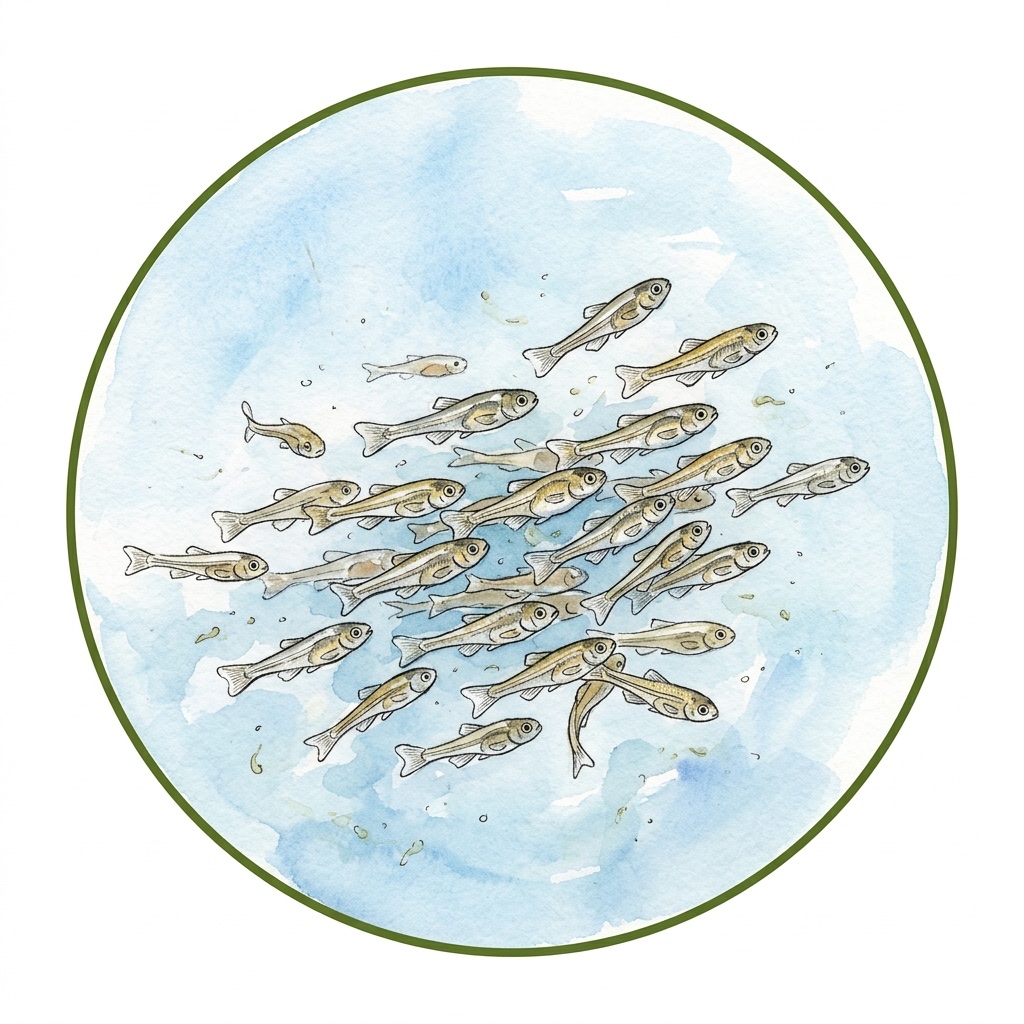
Once the yolk sac is absorbed and the fry begin actively moving over the substrate, start feeding. Microworms, newly hatched baby brine shrimp (BBS) nauplii, and commercial liquid fry food are all accepted, with live BBS producing the fastest growth. Offer tiny amounts five times a day and siphon waste daily to keep water quality pristine. At around four to six weeks the juvenile three-line pattern begins to emerge, and by eight to ten weeks the fry look like tiny adults at 1.5–2 cm. They can be moved to the main tank once large enough not to be threatened by larger tankmates — usually around 2 cm.
Tank Mate Guide
The False Julii cory is one of the most compatible community fish available in the hobby and should be regarded as a near-default choice for any peaceful tropical community aquarium. Their small size, absolute peacefulness, and strict bottom-dwelling habit mean they occupy a niche that almost no popular community fish competes for. The single non-negotiable requirement is group size: False Julii cory must be kept in groups of six or more — eight or ten is better — or they will not display their natural behaviour. Corydoras in groups of one, two, or three become withdrawn, hide constantly, and suffer chronic stress that shortens their lifespans; in a proper school they are confident, active, constantly visible, and a delight to watch. This is not an exaggeration or a soft guideline — it is the single most commonly ignored piece of cory advice, and ignoring it is the single most common way hobbyists end up with lethargic, short-lived cory that never display the behaviour the species is famous for. Buy six minimum; eight or ten if your tank has the floor area.
The school dynamics of False Julii cory are genuinely fascinating to watch once a proper group is established. In a large comfortable school, the fish engage in what enthusiasts call “cory parades” — coordinated movement across the substrate, with the whole school drifting in the same direction like a small herd, pausing to forage together at a favoured spot, and occasionally regrouping to dart up to the surface one after another in rapid succession for air. This surface-gulping behaviour is characteristic of all callichthyid catfishes, which have a specialised hindgut that acts as an accessory breathing organ — they can absorb atmospheric oxygen directly, which is an adaptation to oxygen-poor stagnant pools in the wild. You will see the school rush to the surface together several times per hour; this is normal and healthy, not a sign of distress.
Avoid mixing False Julii cory with large aggressive fish, fast competitive bottom feeders, or known fin-nippers. The key compatibility considerations are: (1) tank mates must be too small or too peaceful to eat or seriously harass the cory; (2) the substrate must remain peaceful — fast aggressive bottom competitors are a poor fit; and (3) water parameters and temperature must match the cory’s moderate-tropical range. Within these limits, the species fits happily into community, biotope, and planted tanks of almost every description. Mixed-species cory groups — for example a school of six False Julii together with a school of six Sterbai or Panda cory — work well when the tank is large enough for both groups to feel secure, though each species still prefers the company of its own kind and will usually school within its species rather than across species.
One practical caution: False Julii cory — like all corydoras — have a mildly venomous pectoral fin spine that can lock in an extended position and tangle in fine mesh nets. When netting or moving them, use a container rather than a net where possible, and if you must use a net use a large smooth one and wet your hands in case the fish needs to be freed. The venom is mild and not dangerous to humans in most cases, but a spine puncture causes a painful sting that can last several hours. The same spine is what makes the species genuinely awkward prey for larger predators — the spine locks open in the predator’s throat, often fatally for both parties — which is why cory are rarely successfully eaten by tankmates that should theoretically be able to swallow them. Even so, deliberately pairing them with predatory fish is a bad bet for everyone involved.
| Species | Why | |
|---|---|---|
| ✅ | Neon Tetra | Classic Amazon community partner. Neons school in the mid-water while False Julii forage the substrate — completely different ecological niches, zero competition |
| ✅ | Cardinal Tetra | Peaceful mid-water schooler from the same broad Amazon biotope; ideal temperature and water-parameter overlap with False Julii |
| ✅ | Rummy Nose Tetra | Another outstanding mid-water schooler; their tight coordinated schooling behaviour contrasts beautifully with the cory’s busy substrate foraging |
| ✅ | Boesemani Rainbowfish | Peaceful active mid-water schooling rainbowfish; adult rainbowfish are too fast to bully cory and too peaceful to threaten them |
| ✅ | Honey Gourami | Gentle surface and mid-water fish; completely ignores the substrate zone and no competitive pressure |
| ✅ | Dwarf Chain Loach | Peaceful bottom-zone coinhabitant; the loach hunts snails, the cory forages for food, and both are similarly armoured and bold |
| ✅ | Peacock Gudgeon | Gentle peaceful mid-level fish; no overlap in foraging zone and both enjoy the same planted tropical setup |
| ✅ | Red Cherry Shrimp | Adult cherry shrimp are ignored entirely by False Julii; very small shrimplets may occasionally be snapped up but established colonies coexist well |
| ✅ | Apistogramma (Dwarf Cichlid) | Most Apistogramma species are peaceful towards corydoras; the cory’s armoured plating means cichlid displays rarely cause injury |
| ✅ | Sterbai Cory | Related corydoras species happily school with False Julii — mixed cory groups are peaceful though each species prefers its own kind |
| ❌ | Large Aggressive Cichlids (Oscar, Jack Dempsey, Flowerhorn) | Large predatory cichlids will attempt to eat corydoras; even if unsuccessful, the cory’s locking pectoral spine can cause fatal injury to both fish |
| ❌ | Large Predatory Catfish (Red-tailed Catfish, large pimelodids) | Outcompete corys for substrate food and actively prey on smaller species; simply too large and too hungry to be safe |
| ❌ | Fast Competitive Bottom Feeders (large loaches, large plecos) | Fast-feeding bottom competitors will steal food before the more deliberate corys can reach it; False Julii are methodical foragers and cannot compete with aggressive speed eaters |
| ❌ | Goldfish | Incompatible temperature and water quality requirements; goldfish are cool-water fish that produce heavy waste incompatible with soft-water tropical corys |
| ❌ | Fin Nippers (Tiger Barbs, Serpae Tetras in small groups) | Nippy fish may harass the cory’s sensitive barbels, causing stress and eventual barbel erosion |
Quick Reference
| Scientific Name | Corydoras trilineatus |
| Common Trade Name | False Julii cory (often sold simply as “Julii cory”) |
| Family | Callichthyidae |
| Origin | Peru, western Brazil — upper Amazon tributaries |
| Adult Size | 5–6 cm (2.0–2.4 in) |
| Lifespan | 5–8 years |
| pH | 6.0–7.5 (ideal 6.5–7.0) |
| Temperature | 22–26 °C (ideal 24 °C) |
| Hardness | 2–15 dGH — very forgiving |
| Min Tank | 80 L for a school of 6 |
| Group Size | 6+ minimum; 8–10 strongly recommended |
| Care Level | Beginner — one of the easiest corys |
| Diet | Sinking pellets/wafers, frozen bloodworm, daphnia |
| Breeding | T-position mating; cold-water trigger; beginner-friendly |
| Tank Zone | Bottom / substrate forager |
| Identification Tip | Three horizontal lines along the flank = C. trilineatus (False Julii); random spots only = true C. julii (rare) |
Related Products
Reviews
Clear filtersThere are no reviews yet.